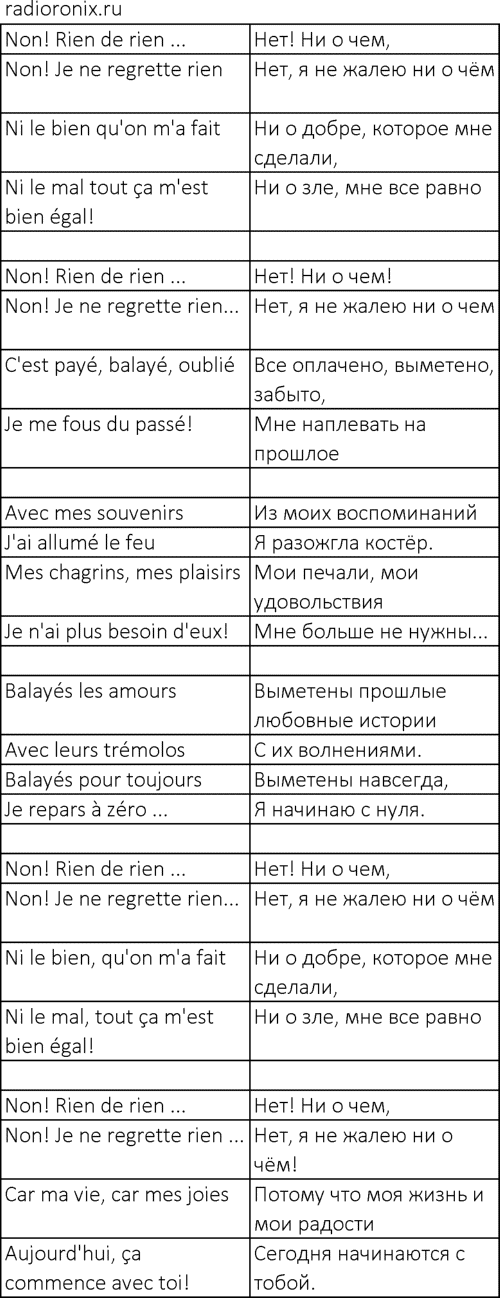
We recall the song "Non, je ne regrette rien" by singer Edith Piaf
“Non, je ne Sorryte Rien” is a French song whose music was written in 1956 by Charles Dumont and whose lyrics were written by Michel Vauceur. Edith Piaf's 1960 recording spent seven weeks at the top of the French Singles & Airplay Reviews chart.
History and meaning of the song "Non, je ne regrette rien" by Edith Piaf
Pictured are Charles Dumont and Edith Piaf. The meaning of the song is easy to understand from its title. In Bernard Marchois's book Edith Piaf, Opinions publiques, the song's composer, Charles Dumont, states that the original title of Michel Vauceur's song was “No, I won't find anything” (Non, je ne trouverai rien) and that the song was written for the French singer Rosalie DuBois. However, when Dumont thought about Piaf, he decided to change the title to “No, I don’t regret anything” (Non, je ne Sorryte Rien).
The divine meaning of the song is that a person has left all the grievances and good moments of life behind. And he started life anew with God.
At that time, Piaf was already feeling unwell due to her illness. She was pale and emaciated, weighing only 40 kg. However, with her characteristic authoritative intonation, Piaf allowed Dumont to play the song on the piano. After listening, having softened, Piaf turned to Dumont with the question: “Did you really write this?” After which they played this song together several more times. It described the ups and downs, good and evil, in general, the life of Piaf herself. Finally she said:
“This is the song I've been waiting for for so long. This will be my biggest success! I want it for my upcoming performance at L'Olympia!”
“When Charles Dumont and Michel Vauceur presented me with the first song “Non, je ne regrette rien”, it was like a kind of revelation for me, as if I had to endure everything and start from scratch. What I found in the songs of Charles Dumont is what I have been looking for for a long time. It's funny, the composer helped me start over. This also helped my previous songwriters who continued to write compositions for me, such as Michel Rivegoche, who also worked with Charles Dumont. They could write in a new way, in a new direction that suited me better than in the past.”
The song “Non, je ne regrette rien” is indeed somewhat autobiographical for Edith Piaf. She, like no one else, can say “no, I don’t regret anything.” She had a difficult childhood and adolescence, an endless series of ups and downs, passionate romances and breakups, grief and joy.
“When I started playing the piano, Edith Piaf’s attitude towards me immediately changed. She required me to repeat this several times—maybe five or six times in a row. She remarked: “This is wonderful, weird. Made just for me."
Edith Piaf lived a full life: growing up in her grandmother's brothel after her father left during the Great War; suffered from blindness between the ages of 3 and 7 years; was married twice; lost her significant other in a plane crash after World War II; and traveled the world with her French chanson. In the book “My Life” Piaf said:
“They say that you have to pay for everything in life. After every trouble, every misfortune, there were so many of them that it would have been enough for ten, I looked for what I was paying for, and did not always understand why life was punishing me. But suddenly it dawned on me! I didn’t pay, but first paid and then received. You see, at first I gave it away, as if fate didn’t believe me, fearing that I would simply take all her gifts and not return anything!”
Within a month, Piaf's "Non, je ne regrette rien" was performed on television, and the record sold 100,000 copies in the first two days of release. This success inspired the singer to a new life and gave her the strength to enter the big stage. Edith Piaf began to sing the song, and the disease subsided.
In the life of Edith Piaf, two things were especially significant: love and music. Despite the many songs, it was “Non, je ne regrette rien” that became a symbol of her work. Piaf recalled how, already ill and almost exhausted, she went on stage:
“The curtain fell, I saw the hall in silence. We decided to start with Dumont, because his melody sounded at the beginning. At that moment I forgot about pain, about fear, about everything that could prevent me from singing. The face covered in cortisone, the cramped arms, the messy hair, the swollen legs—all of this faded into the background. My voice filled the hall, awakened, became stronger, filled every corner of the room. A miracle happened - music conquered the disease, I felt life in myself, I breathed deeply when I sang.”
In 1960, Edith Piaf dedicated the composition “Non, je ne regrette rien” to the French Foreign Legion and the 1st Foreign Parachute Regiment, which subsequently rebelled against French President Charles de Gaulle during the 1961 coup. After the mutiny was suppressed, the regimental command was arrested and the soldiers were transferred to other units. They left the barracks singing a Piaf song.